

My mum needed a new car. He current one is a Daihatsu Cuore from about 1998, it’s a sweet little japanese car that looks bizarrely small and simple on UK roads. It served her well but it’s really starting to show its age. That coupled with increasingly large vehicles on the road and the arrival of her grandson she doesn’t feel safe enough in it anymore. Her one looks like this.
.jpg)
So the plan was to get something slightly more modern, cheap and hopefully electric.
Which car to get?
Scrolling on Autotrader for a couple weeks we quickly realised that there are really only two models of second hand electric car that were going to make sense: either a Nissan Leaf or a Renault Zoe.
The Nissan Leaf was the first commercially produced electric car, the early ones don’t use the standard CCS connector and we were seeing comments online about them having issues with battery thermal management of the battery that lead to faster than expected degradation.
On the other hand, we were seeing a lot of 2014 Zoes going for cheap and reading reddits comments and reviews it seems that lots of people still own and love their 2014 Zoes.
I’m not a car person but people were saying they found them very reliable, that they rarely had to have them repaired and that the battery degradation really wasn’t a big problem. So to simplify our lives we focussed on the Zoes in our search.
Battery Degradation
On the subject of battery degradation, firstly, it doesn’t matter hugely to my mum because her range needs are incredibly modest. Secondly this review of EV battery degradation over five years really makes it sound like a non-issue. Yes the batteries degrade but it seems to be about commensurate with the rate at which any vehicle degrades. ICE vehicles also have a limited lifespan too and it just looks… fine as far as I can tell?
For a 2014 zoe, if we take the headline figure of 2.3% battery degradation per year from the 2020 study (the newer study averages at 1.8 but this is an old car) we’d expect a 2014 zoe to be somewhere about 100 - (2026 - 2014) * 2.3 = 72% battery health1. The Zoe has a 22kWh battery and an estimated range between 100 km (62 mi) in cold weather and 150 km (93 mi) in warmer weather2. So at 70% battery you might expect 70 - 105 km range.
And I haven’t done the lifecycle analysis here but I’m gonna go ahead and assume that in order to offset the carbon emitted by the manufacture of this 2014 Zoe as much as physically possible, it makes sense to keep driving the thing until it’s really, completely dead.
Costs
I chose a random relatively efficient ICE car as a point of comparison. A Toyota Yaris apparently does about 18 km per litre of fuel and at time of writing petrol costs about £1.6 per litre which works out to about 9p per kilometer driven (This fits with the current UK advisory fuel rates). In comparison a 22kWh Zoe in cold weather apparently does about 100km, assuming the charger is about 80% efficient that works out to 0.28kWh drawn from the grid for every kilometer driven. My mum’s current electricity tariff is 20p per kWh so she’d pay about 4-6p per kilometer depending on the weather.
With EV electricity tariffs that can be even lower, Octopus and other providers can give you very cheap energy at night, currently about 9.5p per kWh which would equate to 1.7 - 2.6 pence per kilometer driven. If you have a compatible car or charger you can also give control of the charger to octopus and in exchange they’ll give you electricity for 8p per kWh!
Charging
This brings us to the subject of charging, my mum owns a ground floor flat in a block of about 10 flats. It’s a leasehold so while she can modify things in the interior, I’m not particularly expecting the management agency to let us have a dedicated charger installed.
But luckily for us, her flat has an exterior plug, a dedicated parking space and the run between is about 20m down a unused side of the building. So we bought her a “granny charger” and a heavy duty extension cable. A granny charger is just a cable with a standard UK plug on one end and a CCS EV charging plug on the other. A bit like a USB-C cable, the cable has some smarts in it that talks to the car and says “Hello, you’re allowed to draw 10A from me today”. The granny charger has a little selector to switch between 6/8/10/13A charging. Thankfully it remembers your choice through a power cycle so for now I will just set it to 10A and forget about it.
Interestingly, I learned that while we often refer to the standard UK plug as a 13A plug, it’s actually only rated for 13A for intermittent loads. For constant loads like charging an EV you have to watch out for heat build-up so most plugs are only rated to 10A in that case. From what I’ve read, if you get an EV rated socket and check the wiring you can probably do 13A safely but I have yet to try it.
Anyway, 10A at 240V is 2.4kW. In practice this seems to translate to about 12 hours for a full charge (the numbers don’t add up on that I know) which seems to be plenty fast enough for our purposes.
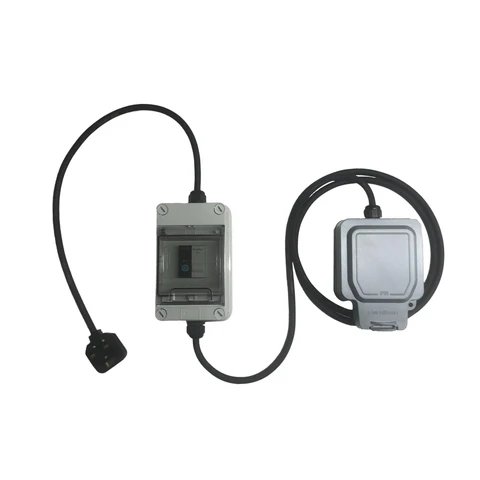

To take advantage of cheaper charging at night we got the extension able with an wifi breaker box that we can set up to turn on at a specific time.
The actual car
So we ended up buying a 2014 Renault Zoe Dynamique Intens (Q210 motor I think) for £2500!
I’m going to publish this now and add to it later as we get more experience with the car but so far it’s lovely to drive and the range is perfectly acceptable for a 12 year old car!
-
I wondered if that should maybe be applied exponentially like a compound interest i.e $(1 - 2.3/100)^{(2026 - 2014)}$ but the graphs look pretty linear and since the rate is low you get similar numbers anyway because the rate is small and $(1 - x)^y \approx 1 - yx$ when x is small. ↩
-
See here for a bit of an intro to this but the reason EVs are less efficient in cold temperatures seems to be a mix of the need to warm the batteries to keep them safe and also the fact that heating the cabin for the human occupant just uses a lot of energy. While in an ICE vehicle you have a convenient source of waste heat that can be repurposed for cabin heating. ↩